 Arcade
Survivor Swarm
Steer a lone lantern bearer through eight minutes of swelling hordes while weapons fire on their own; pick one of three upgrades per level and evolve maxed pairs.
MediumPlays here
SonoTap guide
Compare three survivor browser games by their actual mechanics and goals. Read practical strategy, learn the differences and choose your next session.
ArcadeSteer a lone lantern bearer through eight minutes of swelling hordes while weapons fire on their own; pick one of three upgrades per level and evolve maxed pairs.
 Arcade
Lead one of six wandering swordsmen through a demon horde that surrounds in layers — breach a gap with your skill, Windstep out, and cut down all eight sovereigns.
 Arcade
Steer a self-spinning ring of moon blades through a walled arena — farm red cores to grow, shred rival rings blade for blade, and keep your one core untouched.
Automatic attacks do not make these games passive. They move attention from aiming to movement, collection and the cost of entering danger. Survivor Swarm makes upgrade selection central. Sword Rain Legends adds deliberate skills for breaking an encirclement. Ringblade Brawl makes the visible ring both offensive power and defensive reserve. Choose according to the decision you want to improve after losing: a weapon combination, a badly timed escape or a contact trade that spent too many blades. This is a mechanics shortlist rather than a popularity ranking, and the games do not share an identical timer, end condition or progression system.
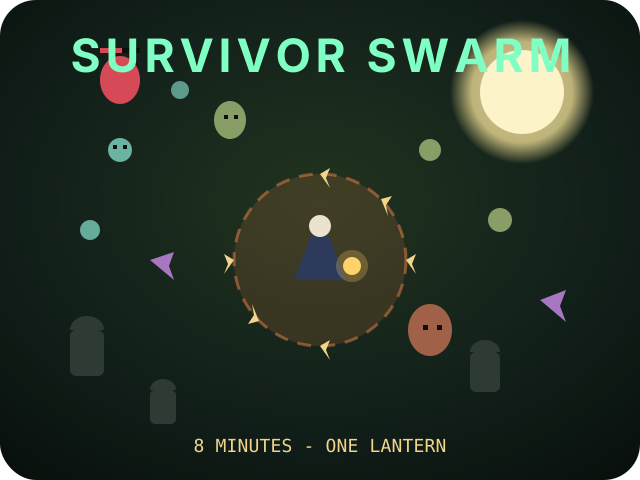
Survivor Swarm is an auto-attack horde survival game where your only verb is movement. You steer a hooded lantern bearer across a moonlit graveyard while up to four weapons fire by themselves: the Seeker Bolt hunts the nearest foe, Orbit Blades circle your body, the Ember Ring burns everything in reach, and the Frost Shard fans out along your movement direction and chills what it hits. Enemies arrive in five weight classes — wisps, ghouls, bats, brutes and a red elite every sixty seconds — and their health, damage and spawn rate all scale with the clock, so the last two minutes are far deadlier than the first. Kills drop experience gems; each threshold opens a draft of three upgrade cards from your current weapons, new weapons and six passives, and elites drop chests that can evolve a maxed weapon paired with its passive into a far stronger form. Survive all eight minutes and dawn breaks; get caught and the run ends, with your best score kept between visits.
Never stop moving, and never run in straight lines away from the pack — circle the swarm instead, so your orbit blades and ember ring grind the front rank while the back rank chases in vain. Grab a second weapon early rather than stacking one to level three; two level-one weapons out-damage a single level-three one and give the draft more options. Read the evolution pairs printed on each weapon card (Seeker Bolt wants Focus Lens, Ember Ring wants Wide Field, and so on) and pick passives with a partner in mind, because one evolved weapon is worth more than three unevolved ones. Spend your dash defensively to cut through a closing gap, not to chase gems. When the elite arrives, kite it around the edge of the arena while your bolts chip it down — its chest is the engine of your whole build. In the final two minutes, give up on collecting distant gems and play keep-away until dawn.
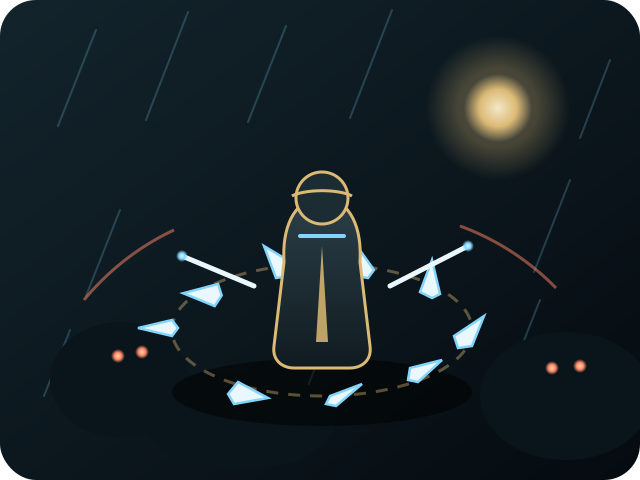
Sword Rain Legends is a top-down wuxia horde-survival game where the demon tide does not trickle toward you — it surrounds you in layers. You play one of six wandering swordsmen whose flying swords chase nearby foes on their own, so your real job is positioning: read the encirclement, breach the weakest arc with a directed hero skill, and Windstep through the gap before the ring closes again. Four realms of sixteen waves stand between you and the eight sovereigns — demon lords like the Pyre Demonlord, the Frostbone Wyrm, and the Ashen Phoenix Emperor — each with its own attack vocabulary and an enraged second form at half health. Runs last minutes, restarts are instant, and records are saved locally in your browser.
Never spend Windstep into a solid wall of enemies: armored elites and packed ranks stop the dash dead, so the survival rhythm is always breach first, then dash. Watch the encirclement gauge near the minimap — it shows pressure and the weakest arc as an arrow, which is where your skill will open the cleanest gap. Breaking out of a tightening ring recharges ultimate energy, so aggressive escapes are literally fuel. Golden pillars drop sword chests that grant eight seconds of Sword Surge; green motes heal. Against sovereigns, sidestep the red warning zones instead of out-dashing them, and save Windstep for the enraged second form, when attack tempo roughly doubles. In the early waves, thin one side of the ring instead of fighting on all fronts at once.
Ringblade Brawl is a top-down arena survival game built around one idea: the blades orbiting you are simultaneously your weapon, your armor, and your health bar. You play the Silver Vanguard, a lone fighter dropped into a walled arena shared with roaming rival rings. You never aim or swing — the ring spins on its own — so every decision is about where to stand. Red cores scattered across the floor reforge new blades into your orbit, thickening the ring from the first Silver Arc tier up through Emerald Gale, Violet Surge, Gilded Sun, and finally Crimson Pyre. When two rings touch, blades destroy each other one for one, modified by size and tier, so every trade spends real steel on both sides. One clean hit on your exposed core ends the run, and restarting is instant.
Spend the opening seconds farming nearby orbs instead of hunting fights — a lone blade loses every trade. Watch the tier banner under your blade count: each new tier means your ring out-trades smaller ones. Never butt heads with a giant ring head-on; flank it, steal the orbs it is farming, and let walls break its line of approach. Clashing always costs blades, so if a trade looks bad, disengage immediately and reforge on orbs before returning. Breakable barricades hide bonus cores behind them, and kills scatter valuable orbs — arriving third to a fight between two big rings is the fastest way to grow. Respect the pendulum gates: their sweeping blades ignore your ring and strike the core directly.
Use Survivor Swarm to practise collecting from areas you have already cleared instead of reversing into a crowd. Move to Sword Rain Legends if an active breakthrough skill sounds appealing, but judge the skill by the exit it creates rather than the number of enemies it hits. Choose Ringblade Brawl when reading a tangible ring of protection is more interesting than choosing cards.
Before retrying, change one cause of failure. Losing health while returning for gems suggests a different route; getting surrounded suggests leaving earlier; losing your ring suggests a more selective trade. Changing everything at once makes the next result harder to interpret. On touch, leave the nearest escape route visible rather than covering it with your hand. A locally saved best is feedback for your own attempts, not a verified leaderboard position. Read each game's controls and finish condition before comparing outcomes across this selection.
In Ringblade Brawl, contact costs blades and therefore protection. Retreating to collect cores rebuilds the resource you just spent. Sword Rain Legends separates the breach skill from Windstep, but a dense armored rank can stop the dash. A useful breach opens a route you can follow, rather than simply hitting many enemies. Start Ringblade in Normal to learn its fragile opening, then try a Sword Rain hero whose skill shape is easy to read. Automatic attacks do not make standing still safe.