 Strategy
Coaster Park
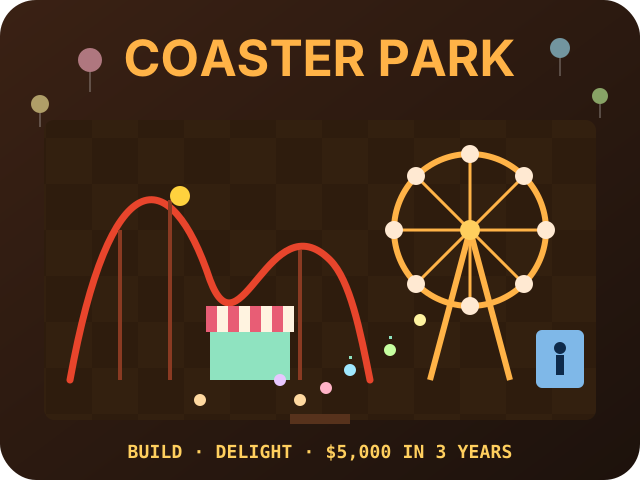
Theme-park tycoon on a 12x8 lot: build coasters, Ferris wheels, snack stalls, and restrooms, keep guests happy, and earn $5,000 profit before Year 3 ends.
MediumPlays here
SonoTap guide
Compare three tycoon browser games by their actual mechanics and goals. Read practical strategy, learn the differences and choose your next session.
StrategyTheme-park tycoon on a 12x8 lot: build coasters, Ferris wheels, snack stalls, and restrooms, keep guests happy, and earn $5,000 profit before Year 3 ends.
 Strategy
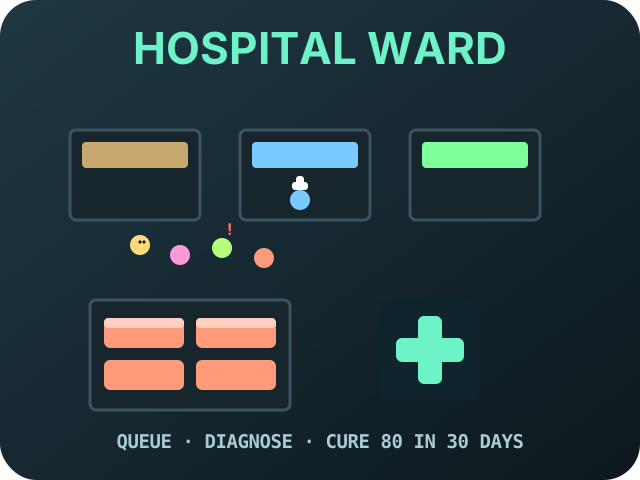
Build GP offices, pharmacies and wards, hire doctors and nurses, move patients through the queues, and keep reputation high while the bills get paid.
 Strategy
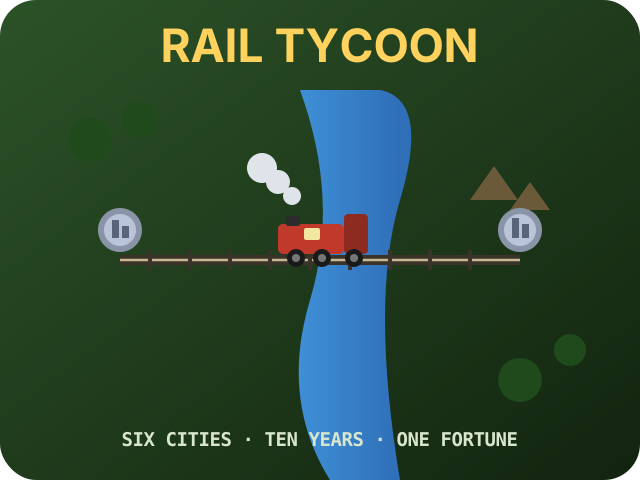
Lay track across hills and rivers to link six cities, buy three generations of locomotives, haul passengers and freight, and build a fortune in ten years.
A useful management game makes a purchase change a system, rather than merely increasing a money counter. These three picks give expansion a cost and a deadline. Coaster Park links facilities with visitor satisfaction. Hospital Ward tests sequential services and reputation. Rail Tycoon requires continuous connections that can earn their next investment. They are compact fictional campaigns, not business-planning tools or models of real healthcare and transport. Choose the system you want to read: space and comfort, queue bottlenecks or network returns. That distinction tells you which information to inspect before clicking Build and which outcome to wait for afterwards.
Coaster Park is a compact theme-park tycoon played on a 12-by-8 dirt lot with a single gate at the bottom. You open with $350 and three in-game years to reach $5,000 of cumulative profit. Each year has 25 days, and a day lasts seven real seconds, so a full game runs under ten minutes. Four attractions are on the build menu. The Coaster costs $2,000, sells $12 tickets, and draws extra visitors every day. The Ferris wheel costs $800 and sells $7 tickets. Snack stalls cost $200 and sell $4 snacks. Restrooms cost $150 and charge nothing, but they keep guests comfortable. Every building has daily upkeep. A happiness meter rises with each kind of ride you own, with up to four snack stalls, and with up to four restrooms, drops sharply if the park has no rides at all, and falls when guests outnumber your park capacity. Each morning, happiness and your coaster count set how many visitors arrive that day.
Your $350 opening cash cannot buy a ride, and a park with no rides takes a heavy happiness penalty. One fast route is to take a single $500 loan on day one and build a Ferris wheel immediately; ten dollars a day is cheap next to the guests it attracts. Once tickets flow, add snack stalls rather than a second wheel: they are cheap, serve quickly, and each of the first four adds happiness. A restroom or two follows for the same reason. Because a busy attraction turns arrivals away unpaid, two cheap stalls usually earn more than one, so spread food across the lot. Save toward the Coaster: it is the only building that adds visitors directly, on top of the happiness boost from owning a second ride type. Watch the Guests figure against your attractions; crowding beyond capacity drags happiness down three points per extra guest. Keep cash comfortably above zero, because upkeep and interest are charged every night and foreclosure triggers at -$250.
Hospital Ward is a clinic management game where the pipeline is the puzzle. Patients with six invented ailments — Disco Fever, Cube Head, Giggle Fits, Invisible-itis, Springy Shoes and Static Hair — walk in through the left-hand door at a rate set by your reputation, queue at Reception, get diagnosed in a GP Office, then route to the Pharmacy for small cases or a Ward bed for big ones. Every room serves exactly one patient at a time, so queues are the enemy: anyone kept waiting twenty-six seconds storms out and costs you three reputation. Treatment is not guaranteed either — the cure rate starts at 82 percent and climbs three points per relevant staff member, and a relapse costs reputation instead of paying the $130 pharmacy fee or $240 ward fee. Doctors cost $500 up front and $60 a day, nurses $300 and $35, and payroll lands every in-game day, so the balance sheet bleeds while you build. Cure eighty patients or reach 95 reputation for an early victory. At the thirty-day deadline, at least fifty patients and 70 reputation are enough to win. Reputation falling to 10 or cash running out closes the clinic.
The correct opening is Reception, GP Office, one doctor and one nurse — $1,400 of your $2,200 — because an unstaffed room is a cash grave, and patients who cannot check in will leave within half a minute. Add the Pharmacy before the first Ward: pharmacy cases are roughly half of all arrivals, cost less to serve, and the $130 fee keeps payroll positive while you save for the $700 Ward. Place rooms near the entrance to shorten travel, but distinguish walking from waiting: only waiting consumes the patience budget. When the HUD shows four or more waiting patients, the answer is a second room of the bottleneck type, not more staff; extra doctors only buy speed and cure rate, they cannot serve two patients at once. Reputation is a flywheel: at 80 reputation, arrivals come about every 2.56 seconds and fees arrive faster, but one bad afternoon of queue rage can spiral you toward the boycott threshold, so pause expansion whenever the waiting count turns red. In the final week, if cures lag the goal but reputation is high, bulldoze a pharmacy and raise a second ward — ward fees fund the sprint and Cube Head cases pay best.
Rail Tycoon is a transport management sim on a 16 by 12 tile map with six named cities: Ashford, Bristol, Cliffside, Dunmore, Ellery and Foxglove. You start with $2,500 and a ten-year deadline to reach $20,000 in company assets. Building is terrain-priced: a station on a city tile costs $300, plain track $50 a tile, and forests, hills and the meandering central river charge up to three and a half times that. Once track continuously connects two stations, the route becomes available and pressing B assigns a locomotive that physically runs the line, paying out on every arrival based on the two cities' combined populations, the route length and the engine's multiplier. Cities linked to the network grow sixteen percent per year while isolated ones crawl at three, so every new connection compounds future revenue. Three engine generations unlock on schedule — the cheap Steamer, the year-four Diesel and the year-seven Volt — and cash dropping below zero at any moment ends the company instantly, which makes expansion pacing the core skill.
Start by connecting two affordable cities and running a Steamer before extending the network. Construction prices depend on terrain, so inspect a complete route before spending most of the initial cash. Keep a reserve for the locomotive as well as both stations. Route around expensive river crossings when a modest detour is cheaper. A Diesel becomes available in year four and increases revenue per arrival, but its higher purchase price still needs to fit the company's cash position. Long routes pay more per arrival, while shorter routes complete their trips more often; compare the whole route rather than distance alone. Assets are cash plus construction investment and sixty percent of locomotive purchase costs. Buying unused track merely converts cash into invested value; it does not raise total assets. Improve productive routes and keep a cash buffer so operating income grows the company before the deadline.
Choose Coaster Park to see facilities and their effects on one plot. Understand upkeep and capacity before saving for a larger attraction. Choose Hospital Ward when the cause of a queue interests you: extra capacity in the wrong place only adds payroll. Choose Rail Tycoon to compare a route's cost today with repeated income after it becomes operational.
Before expanding, name one bottleneck and keep a cash reserve for the next obligation. After buying, wait long enough to see whether the problem disappears or merely moves downstream. A fuller map is not proof of a healthier company. Profit, cured patients, reputation and company assets are different target metrics. Treat the first attempt as a process audit rather than a race to buy every menu item. On touch, check the active construction mode before choosing a tile. Keep one strategic change for the next run so the comparison says something about decisions rather than the amount of scenery you purchased.