 Puzzle
Hashi Bridges
Play Hashi Bridges online. Connect numbered islands with single or double bridges. All islands must join one network without crossing bridges.
MediumSelf-hosted
SonoTap editorial guide
Learn how deductive logic puzzles work, from clues as hard constraints to forced moves, with Hashi Bridges, Akari Light Up and Slitherlink in the browser.
PuzzlePlay Hashi Bridges online. Connect numbered islands with single or double bridges. All islands must join one network without crossing bridges.
 Puzzle
Play Akari Light Up online. Place bulbs to illuminate every white square. Bulbs cannot shine on each other, and wall numbers count adjacent bulbs.
 Puzzle
Play Slitherlink online. Draw one closed loop along grid edges. Each numbered cell specifies how many of its surrounding edges belong to the loop.
A deductive logic puzzle is a small contract between you and the grid. Every clue is a hard constraint, not a hint about what probably happened. The number on an island, on a wall or inside a cell states exactly what must be true in the finished solution, and a correct solve is really a proof: each mark you place follows from clues you have already read, until the board has no freedom left. That is why guessing is optional in this genre. When you feel tempted to try something just to see, there is almost always a readable reason somewhere that settles the question instead.
The three picks below come from Simon Tatham's Portable Puzzle Collection, a set of open-source puzzle engines adapted here for the browser. Each one trains a different deduction muscle. Hashi Bridges teaches connectivity and network planning. Akari Light Up teaches line-of-sight coverage. Slitherlink teaches parity and loop reasoning. All three generate a fresh puzzle after you press Play, with no install and no account, and none of them uses a timer, so the thinking can take as long as it needs. This is an editorial selection by mechanics, not a popularity ranking.
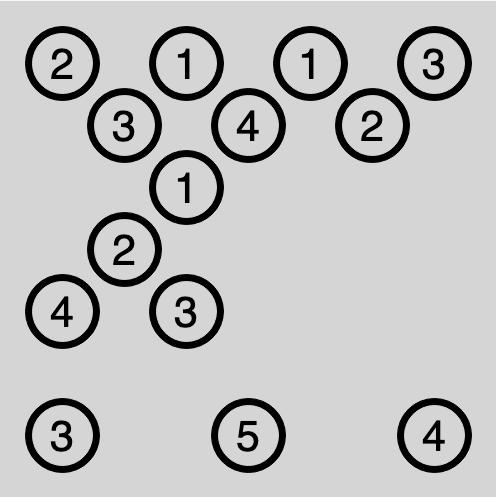
Hashi shows an archipelago of numbered islands. The number is the exact count of bridge ends that must touch that island. Bridges run horizontally or vertically to the nearest visible island, you may build at most two between the same pair, and bridges may not cross. One global constraint sits above the arithmetic: at the end, every island must belong to a single connected network, so a perfectly numbered cluster that is cut off from the rest of the map is still a failed board.
Drag from an island toward its neighbour to build a bridge; repeat the same drag to make it a double, and a third time to remove it. Clicking an island marks it as finished, which is a bookkeeping aid rather than proof that it is correct. Undo, Restart and New sit in the menu, and the Type menu changes the board size. On touch, the same short drag works.
The classic opening deduction is the exhausted island. An 8 with four neighbours needs two bridges in every direction, because doubles are the maximum allowed. A 4 in a corner, with only two neighbours, forces doubles both ways for the same reason. The next habit is the connectivity check: before drawing a bridge that would complete two islands and seal their shared channel, ask how that region still reaches the rest of the map. Open Hashi Bridges and its pattern guide.
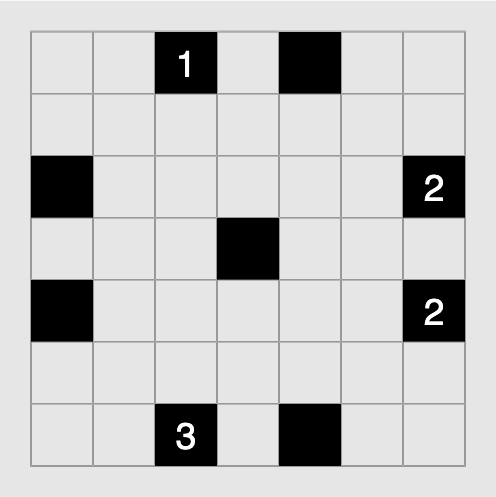
Akari asks you to place bulbs so that light reaches every white square. A bulb illuminates its row and column until a black wall stops the beam, and two bulbs may never shine on each other. Numbered walls add a second kind of constraint: the digit counts only the bulbs directly above, below, left and right of that wall. A finished board has no dark square, no facing bulbs, and every wall number satisfied at once.
Click a white square to place a bulb and click it again to remove it. A secondary click marks a square where a bulb cannot go, and on a phone the Secondary toggle provides that same marking action. Undo steps back through your placements. The marking habit is not decoration: forbidden squares are the notes that make later deductions visible.
Two beginner deductions carry most boards. First, read wall numbers at face value: a 0 forbids every adjacent square immediately, a 4 forces bulbs on all four sides, and a 3 on the outer edge fixes all three of its neighbours. Second, practise the only-source argument — find an unlit square and ask which cells could ever illuminate it; when every alternative has been eliminated, the one remaining cell must hold a bulb even if no numbered wall touches it. Open Akari Light Up and its strategy notes.
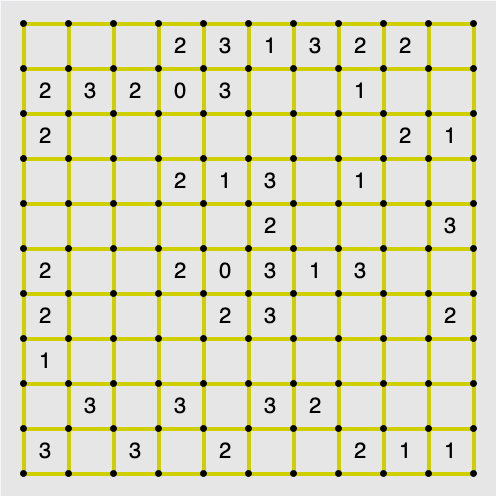
Slitherlink prints numbers inside a grid, and you draw exactly one closed loop along the edges between the dots. A number states how many of its cell's four edges belong to the loop; blank cells constrain nothing directly. The line may not branch or cross itself, and it must be a single ring, so two tidy small loops count as failure rather than partial success. Exclusion marks carry half the logic here: knowing an edge is impossible is as valuable as knowing one is certain.
Click an edge to draw it, and use a secondary click to mark an edge that must stay empty; on touch, enable the Secondary toggle to place those marks and switch it off to draw again. The Type menu changes grid shapes and sizes, while Undo and Restart handle corrections.
The friendliest opening is a 0: exclude all four of its edges at once, then look at what its neighbours lost. A 3 in a corner forces both outer edges, by a tiny proof — if one outer edge were excluded, the loop would dead-end at the corner dot with no way out. Behind everything sits the vertex rule: at every dot, the loop uses either zero edges or two, never one, so a line arriving at a dot with two exits already excluded must take the last one. Open Slitherlink and its worked examples.
Pick the muscle, not the theme. Choose Hashi Bridges if you like thinking about a whole network at once and you enjoy arithmetic that cascades from one forced island. Choose Akari Light Up if you prefer visible consequences, because every bulb draws its own beams and shows you immediately what it changed. Choose Slitherlink if you enjoy parity arguments and the slow satisfaction of a path that must close on itself. If you are unsure, start with a small Akari board: its feedback is the most literal, and the marking habit it teaches transfers directly to the other two. None of the three is the easy one overall; each simply puts its hardest reasoning in a different place.
No. Every puzzle these engines generate is solvable by deduction, and difficulty comes from how many steps a deduction chain has, not from hidden ambiguity. If you are stuck, scan for possibilities you have not yet marked as excluded; the next forced move is usually sitting in a corner you annotated incompletely.
No. Hashi Bridges, Akari Light Up and Slitherlink on SonoTap are browser adaptations built on the open-source Bridges, Light Up and Loopy engines from Simon Tatham's Portable Puzzle Collection. They are not official releases from the original author, and the rules remain the ones described on each game page.
Yes, with small adjustments. Hashi uses short drags, while Akari and Slitherlink rely on the Secondary toggle to place exclusion marks. A larger screen makes long sight-lines and dense edges easier to read, so many players mark their notes on a desktop and finish boards anywhere.