 Arcade
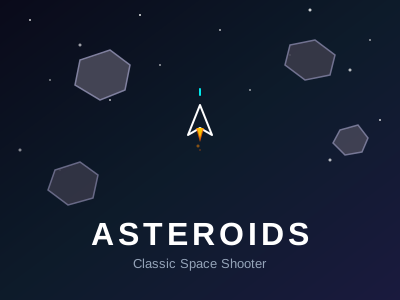
Asteroids
Pilot your ship through an asteroid field — shoot rocks, survive, and beat your high score.
MediumSelf-hosted
SonoTap editorial guide
Score-chasing craft for Asteroids, Snake and Tetris Classic: survival-first habits, risk management and concrete techniques, with controls for each game.
ArcadePilot your ship through an asteroid field — shoot rocks, survive, and beat your high score.
 Casual
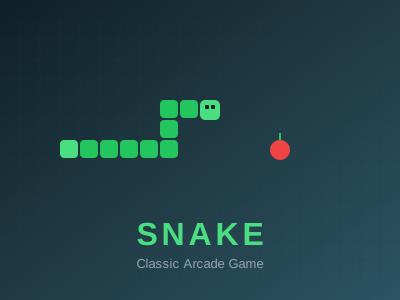
Guide the snake to eat food and grow longer without hitting walls or yourself. A timeless classic!
 Puzzle
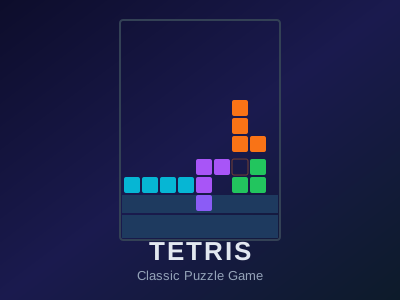
Stack falling tetrominoes to clear lines and score points in this legendary puzzle game.
Casual play ends when the run ends; score-chasing starts exactly there. Chasing a high score means treating survival as the resource that buys scoring opportunities, not as the goal itself. Every classic arcade design here follows the same economy: the safe move keeps the run alive, the greedy move grows the number, and the skill lies in knowing which one the current situation can afford. The three games below are original self-hosted implementations of classic arcade concepts, and each rewards a different version of that judgement. Asteroids is about managing debris and momentum, Snake is about planning routes through a shrinking board, and Tetris Classic is about building a stack that stays alive long enough to pay off. None of them requires reflexes alone; all three reward the habit of thinking one decision further ahead than feels necessary. Start with the game whose pressure profile suits you, learn its controls until they disappear, then work on the techniques below one at a time. These are editorial picks by theme, not a ranking.
Asteroids gives you a triangular ship, Newtonian momentum, and a field of rocks that split into faster fragments when shot. Rotate with the Left and Right arrows, tap Up for thrust, and press Space to fire; on touch screens the on-screen buttons mirror those inputs. The most important discipline is short, controlled thrust taps. The ship keeps drifting until you counter-thrust, and most lost lives come from your own velocity carrying you into a rock, not from the rock's movement. Bleed speed off early by rotating backwards and firing the thruster in short bursts rather than letting a long burn commit you to a direction.
For scoring, the craft is in the order you clear the field. Shoot large rocks from a distance so the splits have room to scatter instead of swarming you at close range, then deliberately hunt the small, fast fragments, because they are worth the most and are also the most dangerous to leave alive. Treat the screen-wrap as information: anything leaving one edge re-enters from the opposite side, including your own ship. A practical survival habit is to keep the ship near the middle, where you have the maximum reaction time from every edge, and only dive toward a rim when you have already planned the exit. Open Asteroids and practise the controls.
Snake's board starts empty and ends claustrophobic, because every piece of food adds a permanent wall made of your own tail. Turn with the arrow keys or WASD, swipe or use the D-pad on touch, and press P to pause; the snake moves forward on its own, and the controls only queue your next turn — you can never reverse directly into yourself. The first scoring habit is to think in loops rather than lines. Coil along the outer edges in wide sweeps and keep the centre open, so you always have a route back to wherever the food appears. Chasing each meal by the shortest path feels efficient but slowly tangles the body into shapes that trap you later.
The second habit is protecting escape lanes. Before any turn, check that the space you are entering has two ways out, not one; a corridor with a single exit is a bet that the next food spawns kindly, and at length the board stops paying those bets. When the tail is long, tail-following becomes the safest pattern: steer in a path parallel to your own body at a respectful distance, because your tail is the one part of the board guaranteed to keep moving away. On higher difficulties, queue your turns a beat early — the snake keeps travelling while you decide. Open Snake and plan your first long run.
Tetris Classic drops the seven tetrominoes into a shaft while the speed climbs level by level. Left and Right move, Up or Z rotates, Down soft-drops, Space hard-drops instantly, and C swaps a piece into the hold slot; a ghost preview shows where the current piece will land, and the next-piece queue lets you plan ahead. The foundational technique is flat stacking: keep the surface of your pile as level as you can, because every bump and hole narrows what the next piece can do, while a flat field accepts almost anything. Holes covered by later pieces are the real run-killers, so prefer a slightly awkward placement that leaves the stack open over a neat-looking one that buries a gap.
The scoring craft is well management. Hold one column — commonly the rightmost — open for the I-piece, and clear four lines at once instead of dribbling out singles, because the big clear is worth far more and resets your stack height at the same time. Use the hold slot deliberately: bank the piece that does not fit rather than forcing it into the stack, but do not hold on reflex every turn, or you end up solving the same problem twice. As levels rise, pre-rotate pieces in the air and commit to a column before the piece is halfway down. Open Tetris Classic and test your stacking.
Pick Asteroids if you enjoy spatial risk management: the threat comes from debris you created, and the skill is choosing when the field is safe enough to go hunting. Pick Snake if you like planning under a tightening constraint, where every point you score makes the board permanently harder. Pick Tetris Classic if you want a pure efficiency puzzle, where the score reflects how clean your stack stays while the clock keeps shortening decisions. All three save your best run locally, so each session has a concrete number to beat. None is objectively the hardest; the honest difference is where the pressure lives — momentum, board space, or time.
In Snake and Tetris Classic, an early tangle or a buried hole often costs more time than it is worth repairing, and restarting keeps practice quality high. In Asteroids, a messy field can still be recovered by slowing down and clearing methodically, which is itself useful training.
Safe, until the safe option no longer exists. Survival is what buys scoring opportunities, so take the greedy line only when you have already identified the exit — a nearby edge-wrap in Asteroids, an open loop in Snake, or a held I-piece in Tetris Classic.
All three offer touch controls, but a keyboard makes the precise inputs easier: thrust taps in Asteroids, queued turns in Snake, and hard drops in Tetris Classic. If you play on a phone, expect a short adjustment period and consider starting on the easier difficulty where available.