Casual · Cycling
Pelican Coast Ride
Ride the coast as a pelican on a bicycle, catch fish, try jumps and tricks, and explore five cameras under a changing sky.
The game's own interface may still be in English.
Overview
Pelican Coast Ride turns a pelican bike game into an unhurried trip beside the sea. A helmeted bird pedals a vintage bicycle while fish appear in four lanes along the coastal road. Steer into a fish to collect it; an ordinary catch adds one point and a golden catch adds five. There is no opponent to overtake, finish line to reach, or survival timer to beat. The pleasure comes from lining up a catch, lifting the bicycle into a jump, trying a no-hands trick and watching the light change over the ocean. Fourteen achievements give the ride small goals, while five cameras let you watch from the side, follow behind, orbit freely, use a cinematic sequence or see the road from the rider's perspective.
How to Play
Choose Start riding or Start muted. Hold W or Up to accelerate, S or Down to brake, and A/D to move between lanes. Space jumps, T performs a trick, B rings the bell and H makes the pelican call. C cycles cameras; dragging the scene opens the orbit camera, and scrolling changes the distance. Q/E change gears manually. P pauses the ride, N advances the clock three hours, M controls music, K saves a screenshot and F opens fullscreen. On touch, use the arrow buttons for speed and lane changes, then tap the jump, wings and bell buttons. The top toolbar opens Settings, pauses and changes fullscreen. The game interface is English.
Tips & Strategy
For a manual ride, open Settings and turn off Autopilot (follow fish). Otherwise, several seconds without steering lets the bird choose a route toward the next fish. Look ahead and make one lane adjustment early: the bike eases toward its target lane, so a late correction can miss a fish even when the button was pressed. Catch one fish before testing tricks, then try a jump and a wing-spreading wheelie on an empty stretch. The side and follow cameras make lane alignment easier to judge than a moving cinematic view. If the scene stutters, choose Low quality in Settings. Day cycle and the hour slider can be adjusted separately, so you can leave the sky moving or linger at a favorite hour.
About This Version
This is a permitted adaptation of pelican-bike, retitled for SonoTap with English menus, achievements and roadside signs. It is presented as a relaxing cycling game rather than a competitive race. The scenery and sound are generated locally, and there is no shared leaderboard or online multiplayer. Compare its leisurely pace with Drift Circuit Rush if you want lap timing and racing rivals.
A view from the ride
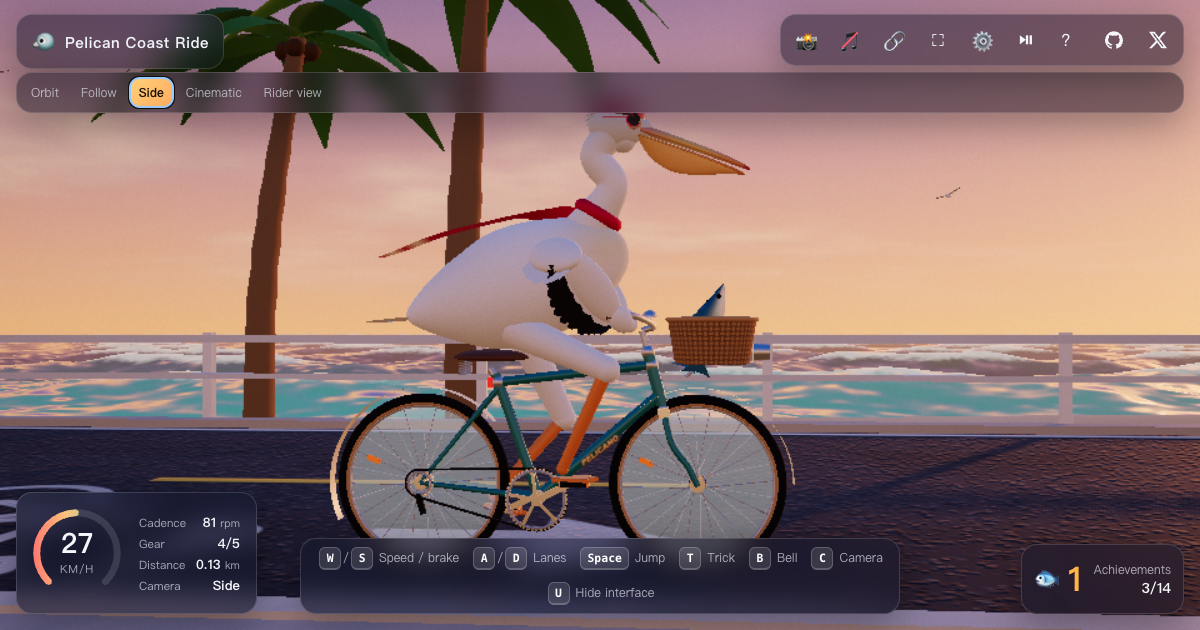
The side camera keeps the bicycle and coastal road in view. The fish counter and achievement counter track different goals. The hour changes the lighting; it does not create a race finish.
Adapted with permission from pelican-bike. Dependency notices.
Controls
- Keyboard
- W/S or Up/Down — accelerate / brakeA/D — change lanes; Space — jump; T — trickC — camera; Q/E — gears; B — bell; H — honkP — pause; N — advance three hours; F — fullscreen
- Mouse
- Drag to orbit, scroll to zoom, or click the pelican, bell and ocean.
- Touch
- Use the arrow, jump, trick and bell buttons. Open Settings to switch off Autopilot for manual steering.
Features
- Fish collecting with ordinary and golden catches
- Five camera views and a day-night cycle
- Jumps, tricks and fourteen achievements
- Optional fish-following autopilot
Frequently asked questions
Does Pelican Coast Ride have a finish line?
No. This is an open-ended coastal ride with fish collecting, tricks and fourteen achievements. There is no race result or survival defeat to complete.
Why does the pelican steer without my input?
Autopilot follows fish after several seconds without steering. Open Settings, expand Riding and switch off Autopilot (follow fish) for manual lane control.
How much is a golden fish worth?
An ordinary fish adds one point and a golden fish adds five. Align your lane before reaching the fish; steering responds gradually.